
An unprecedented collapse and 3,000 trucks a day: the huerna becomes a mousetrap
An unprecedented collapse and 3,000 trucks a day: the huerna becomes a mousetrap
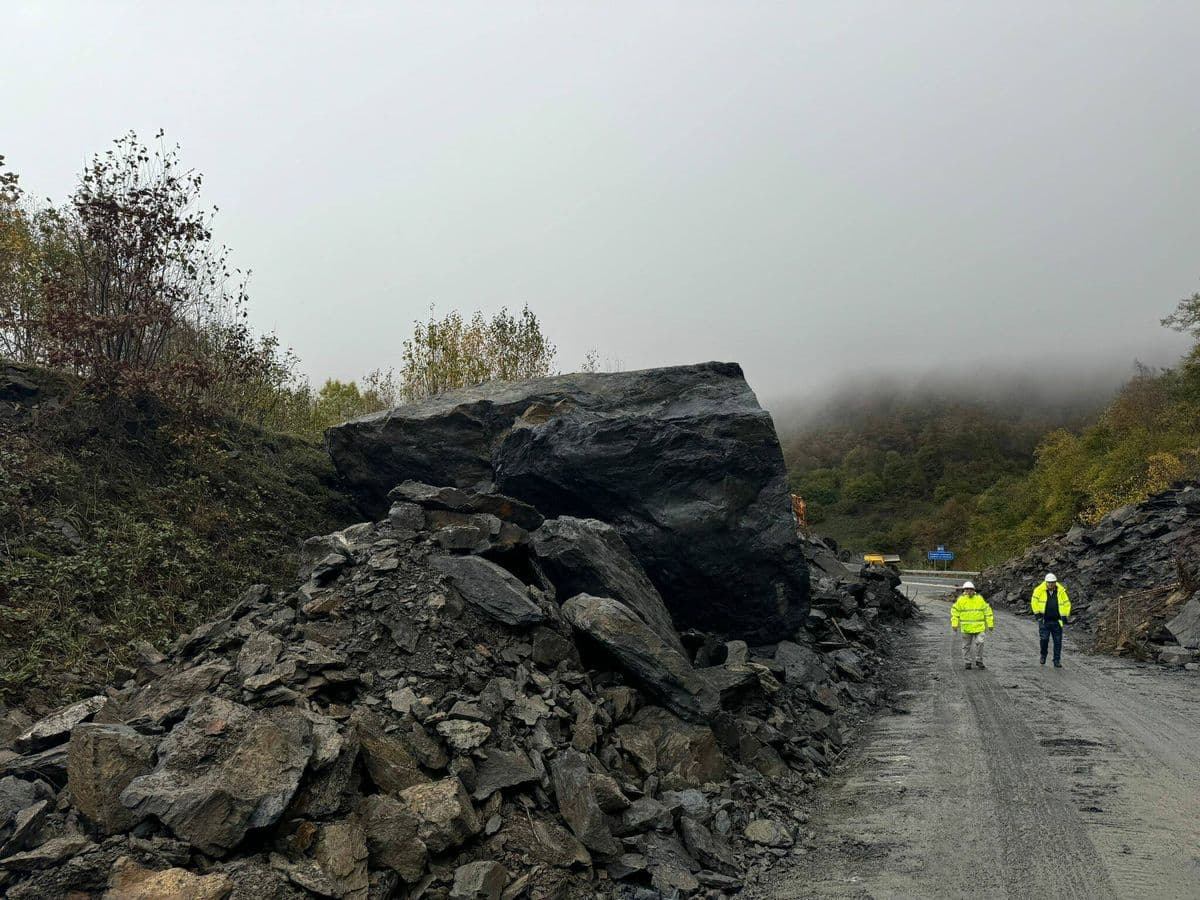
The n-630, the longest conventional road in the country linking gijon with seville, dawned this Monday in its passage through pajares with much more traffic than usual. "We went from 5 cars to 50," said a resident of efe. An average of 6,000 vehicles and 3,000 trucks that usually travel along the ap-66 both to go up to asturias and down to the plateau, are now forced to drive along this secondary road after the landslide that took place on Sunday morning and has prevented passage on the highway at kilometre 76, near the municipality of pola DE Lena. Tons of rocks and mud were falling at the height of the huerna valley at about 10.15 a.m., initially without causing casualties. However, the impact on traffic is notable, as it has affected all four lanes that make up the highway. It is a stretch that was already under the eye of experts.More than a day and a half after the event, the highway is still blocked. Right now the vehicles are diverted by a national road that is not used to hosting this amount of traffic, so the retentions are complicating the day. The main victims are the hundreds of hauliers who use this route, the only one that directly connects asturias with the meseta and for which users pay up to 15 euros in tolls. "The problem is that drivers are forced to go through pajares, which is a national road that passes through many villages and is also frequently cut due to atmospheric phenomena," says Juan jose gil, secretary general of the national federation of transport associations of Spain (fenadismer). In fact, yesterday morning's thick early morning fog conditioned traffic and caused major traffic jams in the mountain pass, with the danger of heavy vehicles travelling on this type of road.
The remedy that fenadismer put on the table is to clear as soon as possible the lane asturias, which is the farthest from the collapsed mountain, and establish a temporary bypass that allows at least one lane to open outward and another back. "It is the only solution to minimize the impact on the sector; There are alternative solutions to the n-630 that have to be implemented." Other organizations in the area such as the asociacion DE empresarios del transporte (asetra) also called for the opening of a highway lane because passing through the national highway means a longer journey time and, therefore, higher costs.
Since Monday morning, conservation machinery of the ministry of transportation is working on the removal of the loosened material. In this sense, the minister of transport, Oscar puente, confirmed in x that the works "are going to be long" and that "therefore, it is going to begin performing a bypass so that traffic can pass with a lane for each direction ", but did not specify when these works will begin to establish it. In addition, the risk of collapse is still active, so that transports are going to temporarily place some protection screens to prevent new landslides from reaching the bypass that is going to be built.
The testimony of various experts from the university of oviedo, collected by efe, agrees with the words of the minister: "it is expected that it will take months to repair the slope on the highway between asturias and Leon." On the one hand, carlos lopez, the dean of the faculty of geology, points out that at this point of the high mountain highway "all the ingredients are present ", given that it is a high altitude slope, with rocks" very fractured and of very bad quality "that are" very exposed "to rain and temperature changes that" degrades and alters "them.
Along the same lines, Daniel arias, professor of geotechnics, points out that faced with this serious landslide, geotechnical studies will have to be carried out, which could last "one or two months," in order to subsequently design the constructive solution and begin restoration actions, which could culminate in the fall of next year. Aucalsa, the concessionaire of the highway in question, assures el confidencial that "the work is continuing, the machinery is working and the situation is being evaluated "; However, no institution has yet determined the possible date of reopening.
Regarding possible victims, sources from the government delegation in asturias confirm that "on Sunday there were drones and specialist dogs and they detected nothing"; However, they maintain that "we cannot guarantee it 100% until the area is cleared, but at the moment we have no evidence that there have been any disappearances. In addition, yesterday the concessionaire inspected the highway security cameras to make sure that all vehicles were controlled." For his part, jose fernandez, secretary of the independent union of autonomous hauliers of asturias, is also concerned about the traffic jams that are now invading the national road, but stresses that "it has been a problem of force majeure, much more cannot be done either. The most important thing is that there are no victims."
This is not the first time that the ap-66 has experienced such an event. In 2006, during New Year's day, large pieces of stone fell from the mountain, practically at the same point due to a strong storm that hit the area. At that time, asturias was cut off from the meseta by a motorway for two days, and it was not until four months later, in April, that the road began to circulate normally. In February 2009 there was also a similar collapse, but this time on the leonese side of the road and with less drastic consequences because at no time did the track have to be completely cut off.